Factory Farms: The Pig's Story
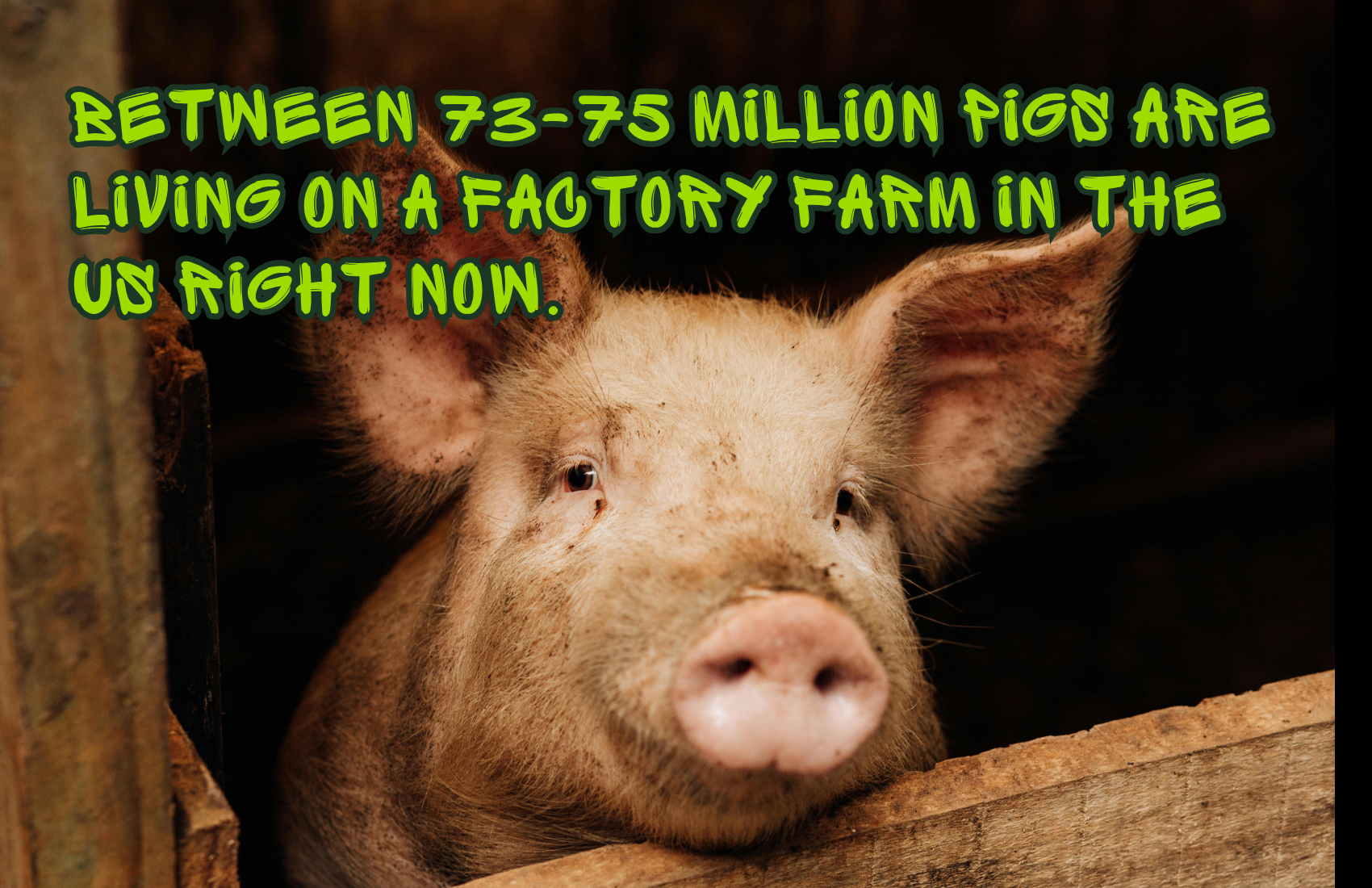
Currently, in the US, 98.6% of all farmed pigs are in factory farms. In our last blog post, we covered how the massive amount of pig waste from factory farms was bad for neighboring communities, drinking water, human health, the environment, nearby aquatic life and worker safety. In this post, we will be talking about factory farming from the perspective of the 73-75 MILLION pigs living in US factory farms right now.
Most people perception of pigs is incredibly misguided. You'll often here that they're dirty, unintelligent, stinky animals that will eat anything. Let's debunk these and figure out where these misconceptions originated from.
Pigs are dirty
Historically, pigs have been kept around human waste, garbage, in muddy lots and cramped pens. Those environments are dirty, but that's mostly because humans have chosen to confine a bunch of pigs to a very small space. Modern pig farms, like the ones we will be talking about in this post, have reinforced this image. They house thousands, and sometimes, tens of thousands, of pigs in indoor spaces. They barely have space to move around, and certainly no room to separate their resting area from where they go to the bathroom.
Are pigs dirty in nature?
In nature, pigs are actually very clean animals when given enough space. They create separate areas for sleeping, eating and going to the bathroom. They very intentionally avoid defecating or urinating in areas where they rest when they have enough room.
Pigs do wallow in the mud, but it's actually because they have very few sweat glands (which is interesting since people are always saying "sweating like a pig"). The mud keeps them cool, protects their skin from the sun and insects, and soothes any irritations.
Pigs are dumb
Historically, we've never given pigs the opportunity to show their intelligence. With companion animals like dogs, we teach them tricks, live side-by-side with them, try to understand them and can observe their personalities and intelligence. With pigs, we've almost only used them for food, and have not gotten to know them as individuals or put in any effort into understanding their cognitive abilities.
In general, people tend to want to think of the animals that they eat as "dumb" because it makes them feel better. We've also heard "dumb" used to describe cows and chickens (bird brain).
Are pigs dumb?
Modern research has looked into this question and here are some of their findings.
- Pigs can remember objects. One study exposed pigs to a sample object for 2 days and they remembered the object for at least 5 days after that. Interestingly, they actually prefer new objects as opposed to ones that they have already seen.
- Pigs can solve puzzles and navigate mazes, especially for food-related rewards. They can even remember the solutions for long periods of time.
- They can recognize individuals, both humans and pigs.
- They can use mirrors to locate food. While they can't recognize themselves in mirrors (like some monkeys), they have been shown to understand mirrors enough to use them. After 5 hours spent with a mirror, the pigs were shown a familiar food bowl, visible in the mirror but hidden behind a solid barrier. Seven out of the eight pigs tested found the food bowl in an average time of 23 seconds by going away from the mirror and around the barrier.
- Pigs can understand symbolic cues.
- They can learn from other pigs.
- Pigs have a perception of time and the ability to anticipate future events. A study was done where female pigs were given two crate options with different confinement times. One was 30 minutes, the other 240 minutes. They showed a preference for the shorter confinement time, which kind of shows us that pigs can get bored and understand how long they've been bored.
- They can learn joystick and computer tasks.
- They also engage in social play like carrying or shaking an object like a ball or stick.
- A researcher from Cambridge said that pigs may have cognitive abilities comparable to that of a 3 year old human child.
Pigs will eat anything
Historically, pigs have been treated like little garbage disposals. Families fed them vegetable scraps, stale bread, spoiled produce and kitchen leftovers. Since pigs would eat things that humans wouldn't, humans just assumed that they would eat anything, instead of the obvious takeaway which would be that humans aren't feeding them enough food that they actually like.
Modern farmed pigs are fed calorie-dense feed and they have been selectively bred for rapid growth and efficient weight gain. They overeat because humans bred them to overeat.
How do pigs eat in the wild?
While pigs are opportunistic omnivores (meaning that they will sort of eat anything if they lack options), they do actually have food preferences. They like to explore different things with their little snouts and will sniff, lick and mouth unfamiliar objects to see what's up, even if they don't plan on eating them. Wild pigs don't typically overeat because they spend a ton of their day actually searching for food!
Most of the unkind pig stereotypes are human manufactured based on our own misunderstanding or just being horrible humans who do horrible things to animals that cause them to behave differently than they would in nature.
What are pigs like as individuals?
Studies have shown that pigs:
- Show optimism and pessimism
- Experience stress
- Become anxious
- Can develop depression-like behaviors under poor conditions
- Comfort familiar pigs
- Recognize individual pigs and humans
- Experience emotional contagion. This is the arousal of emotion in one individual after witnessing the same emotion in another individual (like how some humans will cry when they see another human cry). Basically pigs have empathy!
- In one study, naive pigs (ones that didn't have previous exposure to the situation) was placed with pen mates who had been trained to anticipate upcoming rewards (like chocolate raisins) or aversion events (like social isolation). When the naive pigs were placed in the company of the trained pigs, they adopted the same emotional anticipatory behaviors (ex: ear and tail postures, increased cortisol release) as the trained pigs with the direct experience. They basically witnessed excitement or fear/anxiety and felt that way as well.
Every pig has an individual personality! Researchers have described differences in:
- Boldness
- Curiosity
- Sociability
- Playfulness
- Exploration
- Aggression
- Fearfulness
In nature, pigs live in family groups, multi-generational groups and close mother-offspring relationships. Adult males will often leave the family to start their own families, but the female offspring usually stick around to help raise the next generation of pigs.
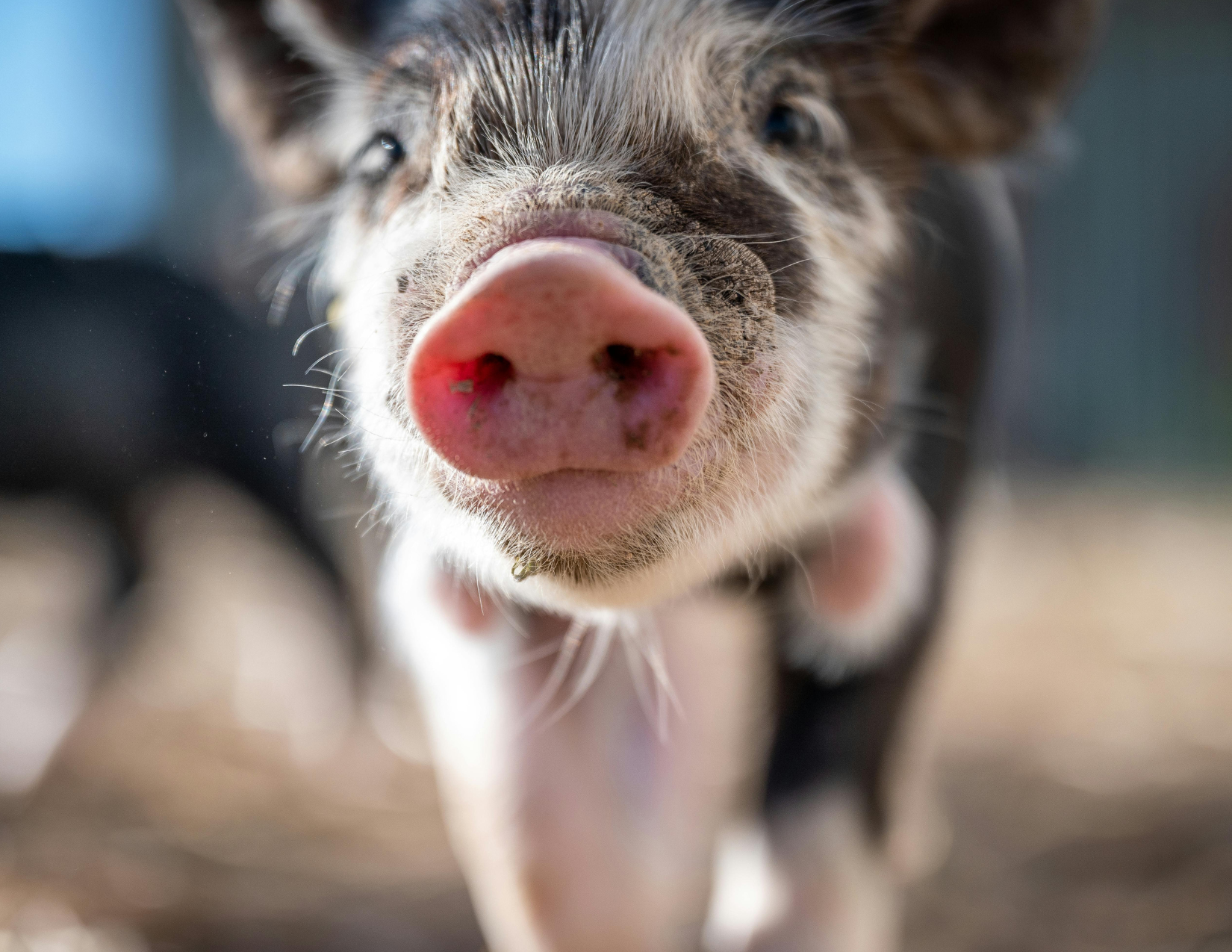
What do pigs need?
Before we get into how the 73-75 million factory farmed pigs living in the US right now actually spend their life, let's cover what pigs truly need to be happy and healthy. This will help lay the groundwork for why factory farming is so horrific from an animal-welfare standpoint.
Rooting
Pigs need to root around with their cute little noses. The pig snout is one of the most sensitive organs in their bodies and they have an excellent sense of smell. They generally spend hours every day digging, rooting and searching for food. They don't do this for entertainment, it's actually an essential behavioral need for pigs.
If they don't get to root, they can have increased frustration, start behaving abnormally (such as biting their little tails), and their aggression levels can increase.
Exploring
Pigs also need to explore. In the wild, pigs are constantly investigating news smells, sounds and textures because they are very curious animals. Exploration and discovery are actually critical for healthy development in pigs.
Cleanliness
We've already touched on this, but pigs need the ability to be clean. They need adequate space so that they can have separate areas for eating, sleeping and going to the bathroom.
Climate control
Since pigs don't have much in the way of sweat glands, it's crucial that they have shade, mud wallows and water to help them cool down and protect their skin from things like the sun and bugs.
The Sad Truth of Pig Farms
Lifespan
For some perspective, wild boards typically live to 4-5 years of age, but some can survive up to 9-10 years. Domesticated pigs (like the breeds living in factory farms) can live up to 10-15 years old, and even up to 20 years of age if they are well cared for.
In contrast, pigs living on a factory farm rarely make it past 6 months old. Female pigs that are used for breeding typically live to 2-3 years of age.
General Welfare
From a very detailed study on the welfare of pigs by the EFSA Panel of Animal Health and Welfare:
The 16 highly relevant welfare consequences identified are restriction of movement, resting problems, group stress, isolation stress, separation stress, inability to perform exploratory or foraging behaviour, inability to express maternal behaviour, inability to perform sucking behaviour, prolonged hunger, prolonged thirst, heat stress, cold stress, locomotory disorders (including lameness), soft tissue lesions and integument damage, respiratory disorders and gastro-enteric disorders. Of these, only inability to perform exploratory or foraging behaviour was considered highly relevant for all the pig categories under consideration.
How much space do pigs get?
Gestation Crates
Gestation crates house individual pregnant pigs (sows). They are only about 7 feet by 2 feet large. The typical size of a pregnant pig is about 6.5 - 7 feet in length, 2 feet in width and 3-4 feet tall, so these pigs literally have no space to move around, and sometimes, even stand up.
The pregnant pigs are confined here for the majority of their 114-day pregnancy and move to farrowing crates shortly before giving birth. The floors are typically bare and slatted, with concrete, metal or plastic so that waste can drop down into manure pits. There are no nesting materials.
Farrowing Crates
Farrowing crates are metal enclosures that are used to house mother pigs just before giving birth and while nursing. These are around the same dimensions as the gestation crates, except that the sides of the crate are designed with gaps that allow the piglets to "safely" access the mother to nurse (and not be crushed). The mother pig is usually moved to the farrowing crates a couple days before giving birth and remains there for 3-4 weeks while nursing the baby pigs.
Factory farms will say that the mother must be separated from her babies in a very small crate to keep her from moving, so that she cannot crush the piglets. However, in nature, this is much less of a concern. Mother pigs possess very strong maternal instincts and deliberately build safe contoured nests which gently guide their babies from danger.
The crushing problem that factory farms are trying to fix is, oddly enough, one that they have mostly created in the first place by not allowing the mother pig to have enough space and resources to build a nest like she would in the wild.
Finishing Barns
Finishing barns are large confinement houses that are designed to hold 1,000 to 2,500 pigs at once. Pigs enter these barns at around 40 - 60 pounds and spend the next 4 months or so there until they weight about 270-280 pounds (and are shipped off to slaughter).
These building also have slatted floors, and each pig only has about 7.2 - 8 square feet of space.
Flooring
The flooring is made of either concrete, metal or plastic. There are no bedding materials and the floor is partially slatted. This can impact the pigs that live in these spaces in a number of ways:
- They can develop joint problems or lameness.
- Lesions and abrasions are very common because of the constant friction against course surfaces.
- Hoof and foot injuries and sole bruising happen often, because of the gaps between slatted floor and the roof edges of concrete can catch their feet.
- Laceration and infections are frequent. Pigs can slip or get their legs caught in the slatted flooring.
- They have no ability to root, nowhere to go, and nothing interesting to explore. This can be really damaging to their health and overall well being.
An Iowa State University study found that 84% of sows (female pigs) at slaughter had one or more foot lesions.
A PubMed study found that the overall prevalence of foot lesions was 93.8%. Joint injuries, hoof problems and leg weakness were sited as frequently occurring issues.
A lot of this is caused by the hard, and often slatted, flooring, but another contributing factor is the genetic breeding that has caused the pigs to grow naturally fast. The extra weight is bad for their joints and cartilage.
Air Quality
Dust in factory farming carries hazardous gases like ammonia and hydrogen sulfide. Hydrogen Sulfide (H2S) is a byproduct of manure decomposition. It's an asphyxiant which means that it displaces Oxygen in your body. One breath can quite literally kill you. Ammonia is also a byproduct of the manure decomposition and is very toxic.
The air quality issues are exasperated because of the "high stocking density" (the pigs have literally no personal space and are all living on top of one another). This causes rapid airborne transmission of bacterial and vital agents throughout the herd.
Because of the poor air quality, 30-70% of the pigs will have some sort of respiratory infection by the time of slaughter. Mortality rates from respiratory disease can be 4-6%.
Indoor confinement increases the risk of pneumonia, influenza and chronic coughing.
Abnormal Behaviors
Tail biting occurs frequently in factory farming and is not considered a normal pig behavior. Tail biting can result in injuries and infections. Factory farms routinely cut off the piglet's tails without anesthesia to prevent tail biting (so they don't lose money, not because they care if the pigs are sick or injured).
Tail biting can occur because of:
- Overcrowding
- Boredom
- Stress
- Lack of enrichment
- Poor ventilation
- Inadequate diet
There are some other stress behaviors that pigs often exhibit. These have been shown in animals that are suffering from deep psychological distress.
- Bar biting
- Sham chewing - repetitive chewing motion (with nothing in their mouth)
- Repetitive head movements
Mortality Statistics
By the time farmers begin to wean the piglets, 9-15% of them will have died. Major causes for this can include:
- Crushing: we talked about this earlier, but this is less likely in nature because the mother pig has room to move around and also the materials and space to build safe nests for the piglets.
- Starvation: modern-day sows are bred to produce unnaturally large litters. This often means that smaller, weaker piglets can struggle to compete for their mother's milk and starve to death.
- Chilling: piglets are very susceptible to cold stress so if the temperature is not well-maintained, piglets can actually die of hypothermia. In nature, they will aggressively seek the mother's body heat for warmth which they can't do in factory farms.
- Diseases: overcrowded and unsanitary practices promote the rapid spread of infectious diseases.
- Piglets are often born with deformities like no anus, clef palate, splayed legs, tremors and hernias.
Within 48 hours, most piglets will have their tails and needle teeth cut off without any pain relief in an attempt to minimize the wounds that piglets inflict on one another.
After 10 days, the male piglets will have their testicles removed, also without any pain relief.
Sow Health
Long-term breeding female pigs (sows) may experience:
- Lameness
- Shoulder lesions
- Reduced body condition
- Chronic injuries
Pregnancy and Nursing
Since so much of pig farming revolves around female pigs giving birth incredibly frequently, it deserves its own section.
Only 3% of all pigs breed naturally in factory farms.
Before giving birth
In nature, mother pigs are incredibly maternal. About 24 hours before giving birth, the wild sows will be extremely active. They may travel long distances searching for the perfect nesting site. They spend several hours building elaborate nests out of grass, branches, leaves, straw and vegetation to keep the piglets safe.
This behavior is driven by hormones and occurs even if they've never seen another pig do it before. It's instinctive. The EFSA (European Food Safety Authority) identifies nest-building as an essential maternal behavior and recommends sufficient nesting materials such as long-stem straw or hay.
That's what happens in nature, but what happens in factory farms is much different. The sow is moved to a Farrowing Crate that severely restricts movement. She can't turn around, walk freely, gathering nesting materials or build a nest. This cruel confinement prevents every single instinct a mother pig has.
When the piglets are born
When piglets are born in the wild, the mother pig will communicate constantly with her new piglets through vocalizations. The babies will nurse on demand and they are able to interact freely with their mother. The mother guides and protects her babies. The piglets are even able to recognize their mother's voice.
In factory farming, the crate restricts most normal interactions. There are literally metal bars between the mother and her children, so that the babies can still access the milk but the mother can barely move or even turn around.
Nursing and beyond
In the wild, piglets will nurse frequently and remain with their mother. They gradually start to explore, but they usually nurse for 10 - 17 weeks, with weaning occurring naturally.
Male piglets usually stick around for 8-10 months, at which age they leave to go live the bachelor life in quest of a mate. Female piglets often remain with their mothers for years, joining the core maternal herd to help raise the future generation of pigs.
In US factory farms, piglets are typically weaned (stop nursing) between 17-21 days old. It's not uncommon for them to be separated from their mother at 14 days or less. Because the piglets' digestive systems and immune systems are not fully developed at that age, the sudden transition to food can cause a lot of stress and lead to complications.
Conclusion
Modern day pig farming is as far from natural as it could possibly be. The details covered in this blog covered standard industry practices, but did not cover the horrific things that happen everyday to pigs in factory farms by the hands of the individuals that work there. If you want to find out more about those details, I would recommend checking out the book Eating Animals or the documentary Dominion.
If you read this and realized enough is enough, and would like to stop funding these horribly broken and sick industries, you can start by reading this blog post on going vegan. If you want to stop eating pigs right now, some good vegan protein sources are tofu, TVP, seitan/vital wheat gluten, tempeh, beans, and lentils. You can find even more vegan protein sources in this free database, which can be sorted by protein % and cost.
If you're already vegan, and want to do more, you can:
- Support animal advocacy groups like ASPCA, The Humane League and Farm Sanctuary, which run campaigns to ban gestation crates and improve farm transparency.
- Contact your federal representatives to push for legislation like the Farm System Reform Act.
- Sign petitions or engage in social media activism.
- Share what you've learned with friends and family.

I’m a Chemical Engineer by trade, but love cooking in my kitchen and coming up with new recipes! I also like knitting in straight lines (I can only make scarves and blankets lol), listening to music (rock and Taylor Swift), hiking and disc golfing!
I went vegetarian when I was 12 years old after a middle school teacher of mine mentioned that he was vegetarian for a few years when he was in the Peace Corps. Before then, I had never heard of or met a vegetarian and didn’t know I had a choice in whether or not I ate meat. Several years ago, I read the book “Eating Animals” and immediately went vegan after finally realizing the horrific realities of the dairy and egg industries (spreading awareness is hugely important because many people really have no idea).

Is leather a byproduct?